Morning Dew and Skin: The Science and Sensation of Water Droplets at Rest
 J. Reeves
Most water experiences are about movement. Rain falls. Pools surge. Rivers pull. But there's a quieter encounter, one that happens before you're fully awake, when dew has settled on bare skin and sits there, perfectly still, doing something surprisingly complex.
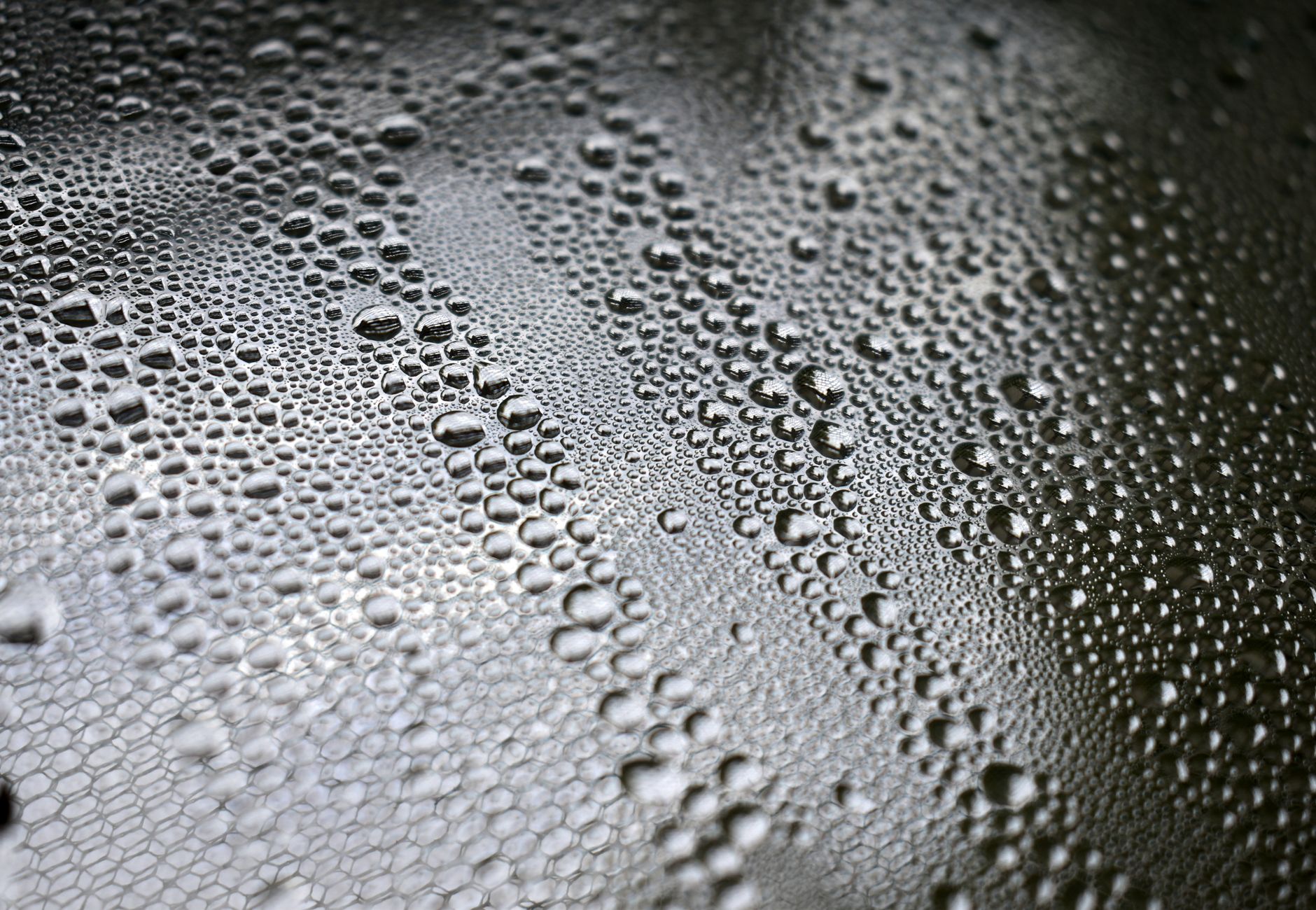 Photo by
 Not all wet is the same wet. A body submerged in a lake and a body touched by a single droplet of morning condensation are having entirely different conversations with water.
Surface Tension Is Doing More Than You Think
When a droplet of water rests on skin, it doesn't simply sit there passively. Surface tension, the cohesive pull between water molecules, holds the droplet in a near-spherical shape, pressing against the outer layer of your epidermis with a force called contact pressure. That pressure is small, yes. But it's real, and your skin registers it.
Skin isn't a uniform surface. It has texture: fine hairs, pores, micro-ridges from your fingerprints, variations in oil distribution. A droplet navigates all of that. On skin with higher sebum content, water beads more aggressively, the contact angle between the droplet and the surface rises, the droplet sits rounder, more separate. On skin that's been washed or is naturally drier, droplets spread and flatten, making broader contact. You can see this difference on your own forearm after a swim versus first thing in the morning: same water, very different behavior.
Photographers know this intuitively. Droplets on oily, unwashed skin catch light differently than droplets on dry, matte skin, the former give you sharp, jewel-like beads; the latter produce softer, more diffuse reflections.
What Your Skin Actually Feels
Here's what surprises people: a droplet at rest creates cold long after the water itself has reached skin temperature. As even a tiny bead evaporates at its edges, it pulls heat from the surface beneath. That localized cooling is felt as sensation, not quite cold, not quite touch. Something in between.
Your skin's thermoreceptors and mechanoreceptors fire together in that moment. It's why dew on the back of your arm feels oddly intimate compared to, say, splashing your face. The stimulus is subtle enough that attention snaps to it fully rather than processing it as background noise.
This is worth thinking about if you shoot aquatic portraits in natural morning light. Early sessions, when dew forms on a subject's shoulders or collarbone, produce a quality of aliveness in the image that a spray bottle simply cannot replicate. Condensation forms from the air itself; it has an evenness and randomness that artificial misting never quite matches. The droplets are smaller, more varied in size, and they sit at angles dictated by the micro-geography of the skin rather than the direction of a spray.
Why Dew Forms Where It Does
Not every part of the body collects dew equally. Horizontal surfaces accumulate more, the tops of shoulders, the flat plane of a forearm held still, the curve of a calf. Dew forms when a surface cools below the local dew point, and exposed, flat surfaces lose radiant heat to the open sky faster than curved or sheltered ones.
Body hair matters too. Fine hair creates nucleation points, tiny scaffolds where moisture condenses and hangs, sometimes in chains along a single hair. On a macro lens, this is extraordinary. On bare, hairless skin, droplets tend to be larger and more isolated.
If you want to understand why a photograph of a shoulder at 6am in a meadow looks fundamentally different from any studio shot: this is why. The dew is site-specific. It formed on that body, in that air, at that temperature. It can't be reproduced after the fact.
Sitting With Stillness
There's something the other water experiences on this site don't offer, not rivers, not cold plunges, not waterfalls. Dew asks nothing of you. You don't swim through it or brace against it. You just exist, and it gathers.
For a site that celebrates wet skin, that quietness deserves its own category. Not every encounter with water is dramatic. Some of the most striking images of wet bodies are the ones where nothing is happening except physics, a droplet holding its shape on warm skin, light refracting through it, the body beneath it perfectly still.
Water finds you in the morning before you decide anything. That might be its purest form.
Get Wet Human in your inbox
New posts delivered directly. No spam.
No spam. Unsubscribe anytime.