River Swimming: How Moving Water Reads Your Body Differently
 J. Reeves
Stand waist-deep in a river and you'll feel something a pool cannot replicate: the water has an opinion about you. It presses against your upstream side, slides around your hips, curls into eddies behind your back. You are, briefly, an obstacle, and the river is negotiating around you.
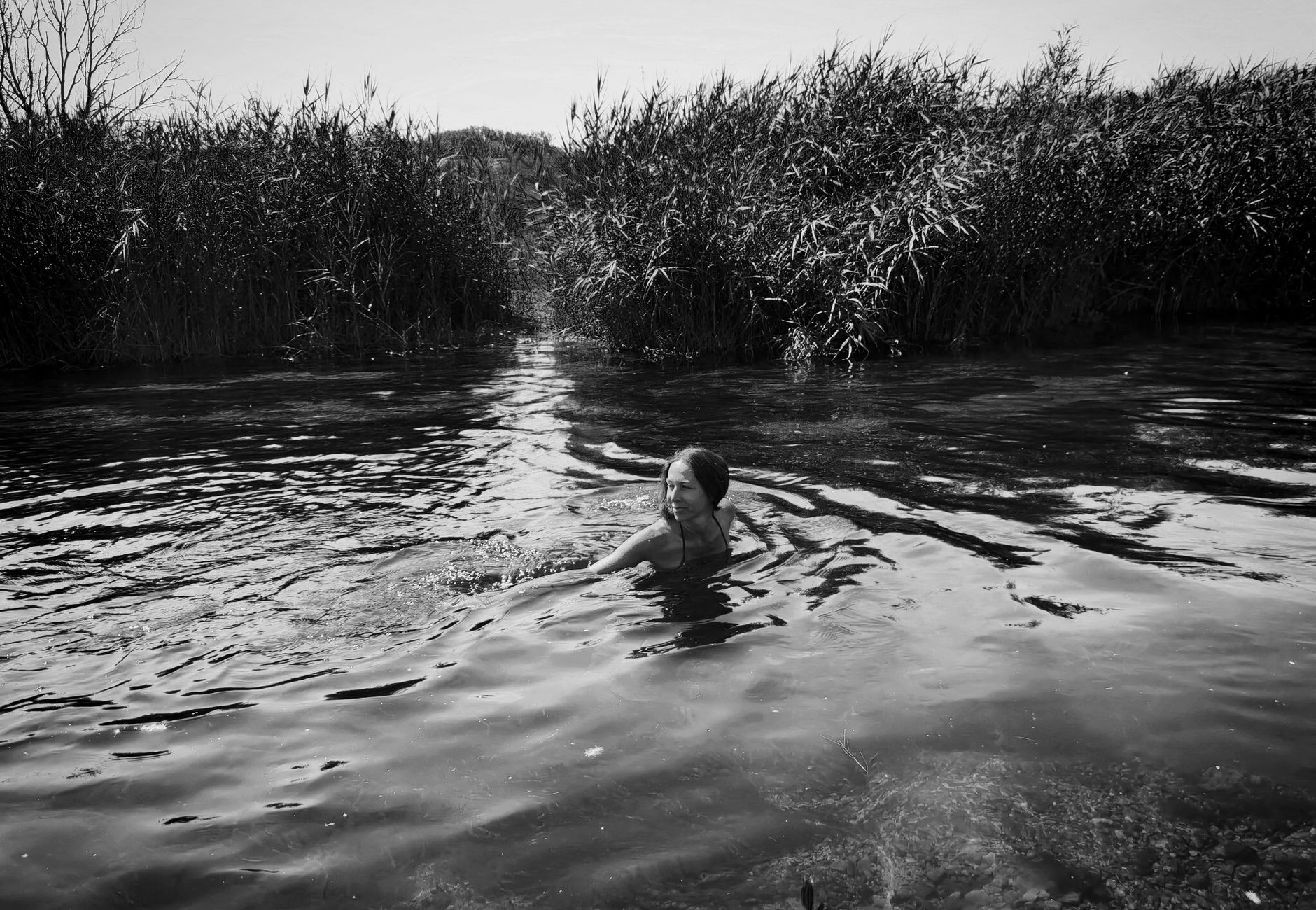 Photo by
 That negotiation is physical, measurable, and felt in ways that are genuinely different from still water immersion. Understanding what's happening isn't just interesting for its own sake. It changes how you experience every river entry you take after.
Pressure Is Never Uniform
In a pool or a lake, hydrostatic pressure wraps your body in something close to equilibrium. It pushes from all sides at roughly equal intensity for a given depth. Rivers break that agreement completely.
Current creates what hydrodynamicists call dynamic pressure, force applied specifically in the direction of flow. Against the upstream face of your body, this stacks on top of the normal hydrostatic load. Behind you, in the sheltered wake, pressure drops. Your body is simultaneously being squeezed from the front and released from the back.
What does that feel like on skin? More alive. The tactile contrast between the high-pressure upstream surface and the slack, almost-warm pocket behind your shoulders is something you can chase deliberately. Turn slowly in a current and feel the pressure map rotate across your body. Few sensations in water are as immediately present as that one.
Silt, Tannins, and What River Water Actually Contains
River water is not chemically neutral, and it is certainly not chlorinated into submission. What's dissolved in it varies wildly by geology, season, and how far upstream you entered.
Glacial rivers carry fine rock flour, particles so small they stay suspended, giving the water its grey-green opacity. That suspended silt creates a very mild abrasive contact across your skin as you move through it; not enough to cause damage, but enough that skin feels slightly different after an hour in glacial melt versus a clear mountain stream.
Blackwater rivers, common in peaty uplands and across much of the southeastern United States, are stained dark with tannins leached from decomposing vegetation. Tannins are mildly astringent. Swim in blackwater long enough and your skin will feel tighter, slightly drawn, the same principle as a very weak tea compress. It's not harmful; some people find the sensation clarifying.
Soft water, low in dissolved minerals, typical of rivers fed by granite catchments, feels almost silky against skin. Hard water, laden with calcium and magnesium carbonates, has more friction to it, a subtle graininess in how it moves across you. Neither is better. They are just different textures the earth has given the water.
Current Speed and the Sensation Threshold
Slow currents, under about 0.5 meters per second, produce a continuous, low-level stroking sensation across exposed skin. Hair on arms and legs moves with it. It reads as gentle, almost meditative.
Push into faster water, around 1–2 meters per second, and the tactile character shifts entirely. The water isn't stroking anymore; it's pulling. Clothing and loose skin tug downstream. The sensation on your face when you turn into current at this speed is close to wind on a fast bicycle ride, a pressure you can lean into.
Above roughly 2.5 meters per second, turbulence dominates. Whitewater environments create a chaotic pressure field where the body receives rapid, irregular impact from all directions at once. This is less a skin sensation and more a full-body percussion. Not everyone finds this pleasurable, but those who do tend to seek it with some devotion.
Why River Skin Feels Different After
Post-swim skin from a river entry often feels different from pool or ocean skin, softer in some conditions, slightly tightened in others. A few things are happening simultaneously.
River water is almost always cooler than pool water, so vasoconstriction plays a role; blood vessels near the skin surface narrow, and skin tone shifts. If the water was tannin-rich or mineral-heavy, those compounds have been in contact with your skin long enough to have mild effects. And the constant current means your skin never fully equilibrated to the surrounding temperature the way it does in still water, there's always fresh, slightly cooler water arriving to replace what your body warmed.
The result is that particular river-swim feeling: skin that seems more defined, somehow. Edges more noticeable. Nerve endings that have been in continuous conversation with moving water for an hour and are still, faintly, listening.
That's what makes river swimming its own category. Not better than a pool, not better than the ocean. Just different in the specific, textured way that moving water is different from still, and worth paying attention to, every time you wade in.
Get Wet Human in your inbox
New posts delivered directly. No spam.
No spam. Unsubscribe anytime.