Infinity Pools and the Horizon Line: Why Edge-Water Feels Different on Skin
 J. Reeves
There's a specific kind of stillness that happens at the edge of an infinity pool, right where the water seems to pour itself into the sky. People talk about the view. Nobody talks enough about what that edge does to the skin of the person floating near it.
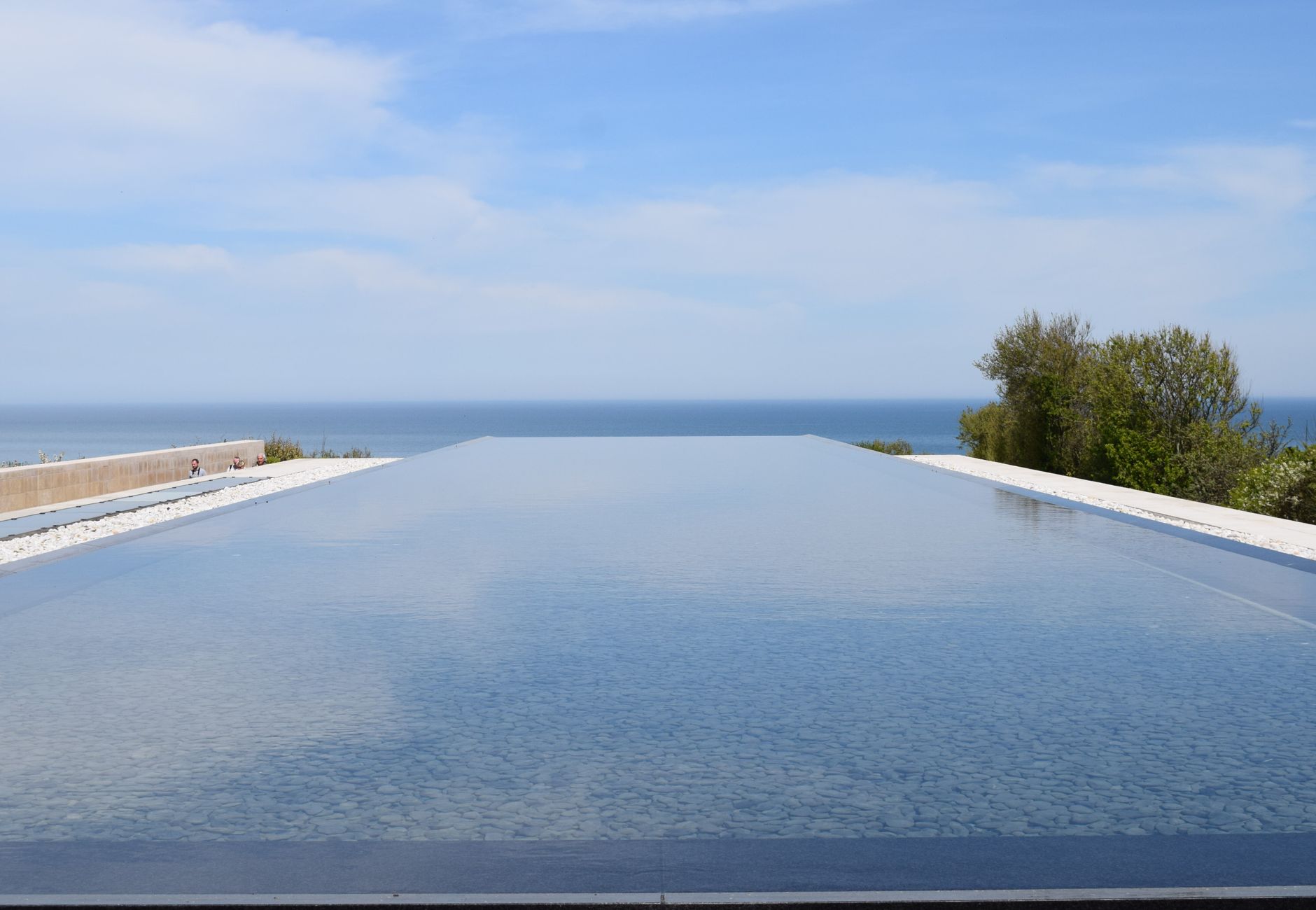 Photo by Gaëtan Ouille on Pexels.
Most pools announce their boundaries. Tile, coping, a visible wall. Your body knows where the water stops because your eyes tell it so. An infinity pool removes that cue. The horizon line blurs the far edge of the water into whatever lies beyond it: ocean, valley, sky. Your skin keeps receiving the same mechanical information, buoyancy, surface tension, the faint drag of water against hair follicles, but your brain is getting a visual signal that contradicts it. That mismatch is part of why floating near the edge of an infinity pool feels almost dreamlike. You're wet and weightless in a space that looks like it shouldn't hold you at all.
The water itself is often different, too
Infinity pools are usually heated, filtered aggressively, and kept at a narrower temperature band than a lake or the sea, because the whole design depends on stillness. Wind ripples ruin the illusion. So resorts and architects tend to shelter these pools, which means the water sits calmer and warmer than almost anything you'll swim in outdoors. Calm warm water behaves differently on skin than anything with current or chop. It clings longer. Droplets bead rather than sheet off, because there's no movement pushing them along. If you've ever noticed how your arms look almost lacquered when you pull them out of still, warm water, that's the effect: a thin, even film that takes its time evaporating.
Catch basin water adds its own texture
The thing most swimmers don't think about is the catch basin, the hidden trough that collects the water spilling over the visible edge before pumping it back up. That water gets turned over constantly, filtered and recirculated at a faster rate than the main pool body. It's often slightly cooler and carries a faint mineral tang depending on the filtration system. Swim close enough to the edge and you'll feel a subtle temperature seam, almost a second water within the water, right where the overflow begins.
graph TD
    A[Main Pool Body] --> B[Overflow Edge]
    B --> C[Catch Basin]
    C --> D[Filtration]
    D --> E[Return Jets]
    E --> A
Photographing it is its own problem
Anyone who's tried to shoot an infinity pool knows the edge is both the whole point and the hardest thing to capture well. Shoot from water level and the horizon disappears into glare. Shoot from above and you lose the sensation of weightlessness that makes the pool worth photographing in the first place. The best images tend to isolate a single wet shoulder or a dripping hand right at the point where the water seems to vanish, letting the skin do the work of showing scale that the water itself refuses to show.
There's also a light quality specific to these pools. Because they're almost always built to face open sky, water, or low terrain, the reflected light bouncing off the surface tends to be softer and more diffuse than a walled pool surrounded by concrete. Skin photographed at the edge of an infinity pool often reads warmer and smoother in frame, not because of anything chemical in the water, but because the light hitting it has nothing nearby to bounce off and harden.
Next time you're floating at one of these edges, pay attention to where your skin actually registers the water versus where your eyes tell you it should stop. The gap between those two signals is the whole sensation. It's a small, strange kind of vertigo, wearing nothing but water, that most infinity pools are quietly designed to produce.
Get Wet Human in your inbox
New posts delivered directly. No spam.
No spam. Unsubscribe anytime.