Mangrove Swimming: What Brackish Tidal Roots Actually Do to Your Skin
 J. Reeves
Few swimming environments are as misunderstood as mangroves. People picture murky water, tangled roots, and things that bite. What they miss is something genuinely strange and beautiful: water that stains, softens, and holds you differently than any ocean or river can.
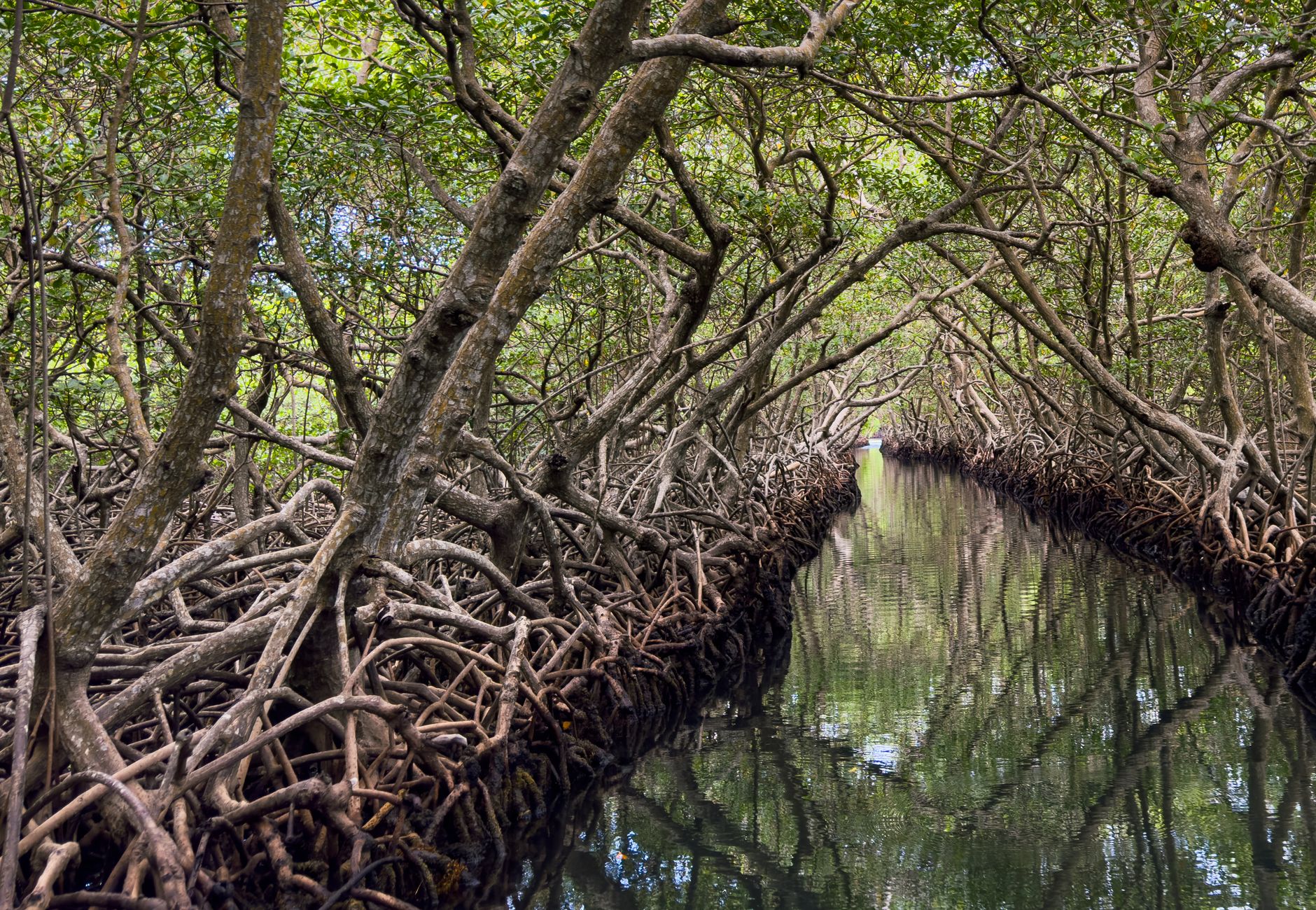 Photo by Faith Bissen on Pexels.
Mangrove water occupies its own chemical category. Salt pushes in from the sea with each tide. Freshwater drains down from inland. The roots themselves leach tannins continuously, the same compounds that turn tea amber and give red wine its grip. Swim in a mangrove channel at low tide, when the water is slow and shallow and warm, and you are moving through something closer to a light botanical infusion than to ocean water.
What does that actually feel like on skin?
The Tannin Effect
Tannins are astringent. On skin, they bind loosely to surface proteins, creating a mild tightening sensation that most swimmers notice within ten minutes. Your forearms feel slightly firmer. The water seems to grip you, not slow you down exactly, but resist you in a way that feels personal rather than physical.
This is real chemistry. Polyphenols in mangrove tannins interact with keratin at the outer layer of skin, temporarily contracting pores. The sensation is closest to the feeling of strong black tea on the back of your hand, stretched across your entire body. Pleasantly strange. Some people find it mildly numbing along the shins and shoulders where skin is thinner.
After you exit, the tightening fades within twenty minutes. What remains is a subtle warmth, not heat exactly, more like the skin has been gently worked over.
Salt Concentration and Skin Hydration
Mangrove water salinity shifts constantly with the tides. Near high tide, salinity can approach 25 to 30 parts per thousand, close to open ocean levels. At low tide, especially after rain, it can drop below 10 parts per thousand. Your skin is constantly adjusting its osmotic response.
At higher salinity, the water draws moisture toward the surface through osmosis, which temporarily plumps the outer skin layer. Swimmer's skin in open ocean tends to dry out quickly post-swim; mangrove water behaves more unpredictably. The tannin layer partially seals the surface, slowing that moisture loss. Many swimmers report that their skin feels more supple after a mangrove swim than after an equivalent ocean session, at least in the short term.
The trade-off: prolonged exposure at high salinity still strips the skin's lipid barrier. Rinse with fresh water after. Take your time doing it.
Temperature and the Root Canopy
Open water heats evenly in the sun. Mangrove channels do not. The root canopy filters light into shifting columns. Swim under a dense overhang and the water drops three to four degrees Celsius within a few body lengths. Move back into a sun-lit gap and warmth returns almost immediately.
These micro-temperature shifts do something interesting to the body's surface circulation. Blood vessels near the skin expand in warmth, contract in the cooler shadows. The effect, repeated through a long swim, amounts to a kind of passive vascular exercise. Skin flushes visibly in the warm patches. In the cool root shadows, it draws pale and taut.
Photographically, this is extraordinary. The dappled light through mangrove canopy creates striped illumination on wet skin that moves with every ripple. Tannin-dark water reflects amber and gold below the surface; above it, cool blue-green shadow. A swimmer in that light looks painted.
graph TD
    A[Tidal Saltwater Enters] --> B(Mixes With Freshwater Drainage)
    B --> C{Mangrove Root Zone}
    C --> D[Tannins Leach Into Water]
    C --> E[Temperature Gradients Form Under Canopy]
    D --> F(Skin: Astringent Tightening, Pore Contraction)
    E --> G(Skin: Circulation Response to Heat/Cool Cycling)
What the Mud Underfoot Does
Mangrove substrate deserves its own mention. The sediment is fine, anaerobic, and rich in decomposed organic material. Where your feet sink into it, the mud is notably warm compared to the water column. It clings without scratching, unlike sand. Some coastal cultures have long used mangrove mud as a skin treatment; the silica and mineral content is real, though the research on therapeutic effects is thin.
What is consistent: the sensation of soft mud between your toes in warm brackish water, with root shadows crossing your shoulders, is deeply specific. You will not mistake it for anything else you have ever swum in.
Mangroves reward slow swimmers. Drift rather than stroke. Let the water tell you what it is.
Get Wet Human in your inbox
New posts delivered directly. No spam.
No spam. Unsubscribe anytime.