Humidity Sweat vs Water Sweat: Why Your Skin Can't Tell the Difference (But Should)
 J. Reeves
Stand outside on a muggy August afternoon and you'll be wet within minutes without ever touching water. Stand in a lake for the same five minutes and you'll be wet too. Your skin, weirdly, treats these two kinds of wet almost identically at first contact, even though the chemistry and the feeling underneath are nothing alike.
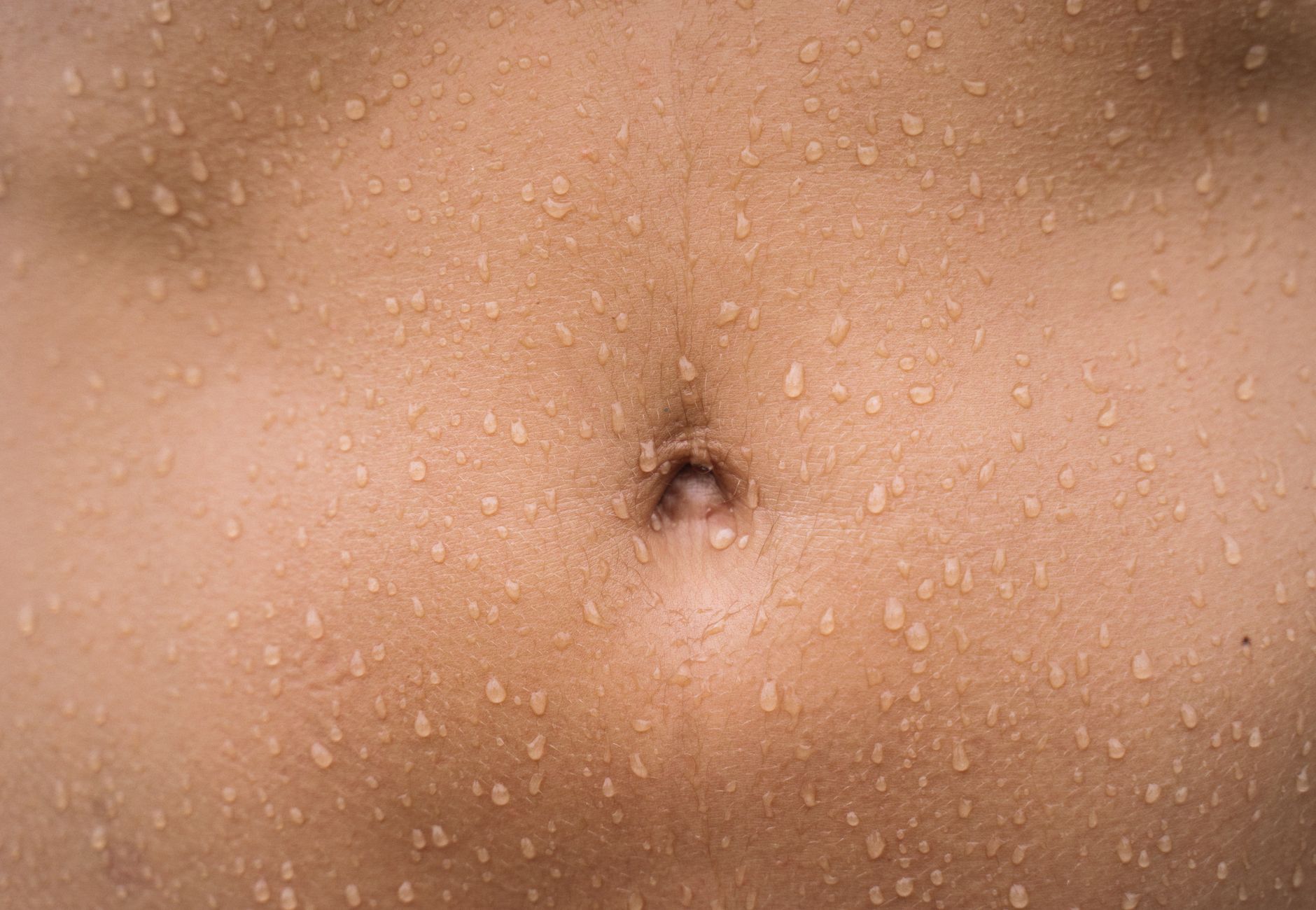 Photo by Anna Tarazevich on Pexels.
Sweat is your body's own fluid: mostly water, but carrying salt, urea, lactate, and trace amounts of whatever your body is trying to offload. It leaves through eccrine glands and sits on the skin's surface as a thin film. In high humidity, that film doesn't evaporate efficiently because the air is already saturated with moisture. There's nowhere for the sweat to go, so it pools, spreads, and clings. This is why humid heat feels so much worse than dry heat at the same temperature: your cooling system is working, producing fluid exactly as designed, but the physics of evaporation have been switched off.
Water contact is a different mechanism entirely. When you swim or shower, water moves onto skin from outside, with its own mineral load, temperature, and pressure. There's no evaporative cooling stall because the water isn't trying to evaporate off your skin to cool you; it's just sitting there, or moving across you, doing its own thing. Your skin's nerve endings register this as external pressure and temperature change rather than the slower, saltier, warmer sensation of your own sweat building up.
Here's the part most people miss: sweat and humidity-trapped moisture actually degrade the skin barrier faster than clean water exposure does. Sweat's salt content, combined with trapped heat, breaks down the lipid layer that keeps skin plump and protected. That's part of why skin can feel gritty, tight, or irritated after a muggy day even if you never got near a pool. Compare that to a swim in cool, relatively clean water, where the skin barrier often comes out intact or even temporarily smoother, because there's no salt residue sitting in place for hours.
graph TD
    A[Humid air] --> B[Sweat produced]
    B --> C{Can it evaporate?}
    C -->|No, air saturated| D[Film sits on skin, salt and heat trapped]
    C -->|Yes, dry air| E[Evaporates, cools skin]
    F[External water contact] --> G[No evaporation needed]
    G --> H[Pressure and temperature register directly]
There's also a perceptual trick at play. Humans are bad at distinguishing "I am wet because of my own body" from "I am wet because of the environment" without visual confirmation. Studies on thermal perception have shown that people misjudge humidity-driven dampness as rain or splashed water fairly often when blindfolded, because the nerve signals for moisture plus warmth are similar regardless of source. Your skin has sensors for pressure, temperature, and vibration, but no dedicated sensor that says "this moisture originated internally." It's inferred, mostly from context and smell.
This matters for anyone paying close attention to how their skin looks and feels across a day, which, if you're reading a site devoted to wet skin, is presumably you. A day spent sweating in humidity without rinsing is quietly rougher on your skin than an equivalent amount of time wet from a pool or a rain shower, even though both leave you looking equally damp in photos. The sweat day leaves salt crystallizing in pores and a barrier slowly thinning from the inside out. The swim day, assuming reasonably clean water, tends to leave skin cooler, tighter in the good sense, and less likely to break out along the hairline and back.
If you want proof, try this: next humid day, towel off with a plain water rinse halfway through instead of just wiping sweat with a towel. Most people report their skin feels immediately different, less tacky, less hot, more like it does after an actual swim. That's the sweat-versus-water gap showing up in real time, not just in the data.
Get Wet Human in your inbox
New posts delivered directly. No spam.
No spam. Unsubscribe anytime.