Monsoon Swimming: What Warm Tropical Rain Does to Your Skin When You're Already Wet
 J. Reeves
There is a specific moment in monsoon season that swimmers in Southeast Asia, South Asia, and the Gulf Coast know well: the sky opens while you're already in the water. You're submerged to your shoulders in a warm river or lagoon, and suddenly rain is hitting the surface all around you, hitting your face, your shoulders, running down your neck while your legs drift below. Two kinds of wet, meeting on the same body at once.
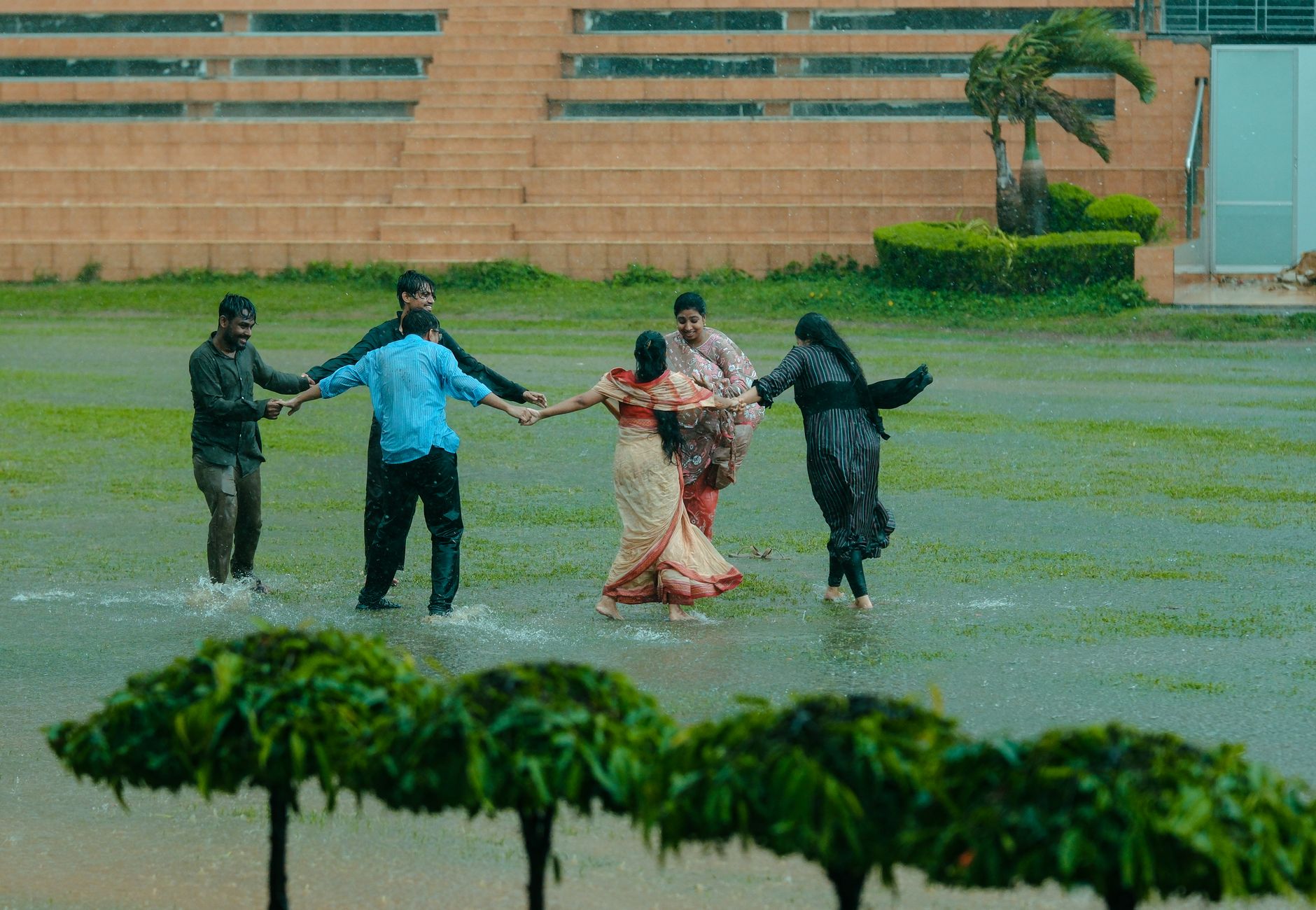 Photo by Md Nadim Mahmud on Pexels.
That layering is the thing worth paying attention to. Most discussions about rain on skin assume dry skin as the starting point. Monsoon swimming flips that entirely.
What Monsoon Rain Actually Is
Monsoon rain isn't uniform. In the early season, storms tend to be intense and brief: large, fast-falling drops carrying significant kinetic energy. By mid-monsoon, rain becomes steadier and finer, sometimes almost warm to the touch because it falls through humid air that barely cools it. In coastal tropical zones, rainwater temperature can reach 26–28°C before it lands.
That matters for skin. Cold rain landing on warm skin creates a sharp vasoconstriction response: blood vessels near the surface tighten, you feel the impact as a small sting or prickle. Warm monsoon rain does something different. Drops close to body temperature register more as pressure than temperature. You feel the weight of them, the rhythm, without the thermal contrast.
Skin reads water through a combination of mechanoreceptors (pressure and vibration) and thermoreceptors (temperature differential). When the temperature gap closes, mechanoreception takes over almost completely. Warm monsoon rain turns into pure percussion.
The Skin Already Submerged
Here's where it gets interesting. Skin that has been immersed for ten or more minutes undergoes measurable changes. The outer layer of the stratum corneum absorbs water and begins to swell slightly. The surface becomes more permeable, more sensitive, and the wrinkling response (driven by vasoconstriction in the fingertips and toes) redistributes the skin's mechanical tension.
When monsoon rain hits that already-saturated skin, two things happen at once. First, the rain can't be absorbed in the usual way because the skin is already at or near water saturation; the drops simply sheet off. Second, the swollen outer skin layer transmits vibration differently than dry skin would. Impact sensations feel amplified in some areas and muted in others, depending on how the underlying capillary bed has shifted.
Shoulders and the back of the neck tend to register rain drops most distinctly during monsoon swims. These areas are often partly above the waterline, exposed and subject to both rain impact and evaporative cooling between drops. The contrast between the warm water below and the falling rain above creates a boundary sensation that's hard to describe and genuinely hard to replicate in any other setting.
Rainwater vs. River Water: What Your Skin is Actually Touching
Monsoon rainwater is nearly distilled: low mineral content, slightly acidic from atmospheric CO₂ forming weak carbonic acid (typically pH 5.6–6.0 in clean air, lower near urban pollution). River and lagoon water in tropical monsoon zones carries dissolved organics, sediment, and often elevated microbial content from runoff.
Your skin is simultaneously touching both. The rain landing on your shoulders is soft and slightly acidic. The water your torso is submerged in is harder, warmer, biologically rich. Some swimmers notice the difference without being able to articulate it: the top of the body feels cleaner, lighter, while the submerged lower body feels warmer and more enveloping.
This division isn't just sensation. The soft, low-mineral rain landing on skin exposed above the waterline does reduce surface tension slightly, which affects how water sheets across the body. Watching rain hit a wet shoulder and run off in thin, fast rivulets is one of the small visual pleasures of monsoon swimming that photography consistently tries and often fails to fully capture.
What the Rhythm Does
Steady monsoon rain creates an acoustic environment as much as a physical one. The continuous impact of drops on water surface generates white noise that muffles the usual auditory cues of an outdoor swim. That sensory narrowing is real. Without the audio of wind, birds, or distant traffic, what remains is impact and immersion: the feel of the river moving past your body, and the feel of rain landing on whatever's above the surface.
Swimmers who regularly train in monsoon conditions describe this state as unusually focused. Not relaxed exactly. Present. The skin's input becomes the dominant signal because the other channels are quieted.
Two kinds of wet, one body. The physics are straightforward. The experience is something else.
Get Wet Human in your inbox
New posts delivered directly. No spam.
No spam. Unsubscribe anytime.