Tidal Flat Skin: What Exposed Seabed Water Does to Your Body
 J. Reeves
Stand barefoot on a tidal flat at low tide and you're standing in one of the strangest aquatic environments on earth. Not quite ocean. Not quite land. The water pooling around your ankles is warmer than anything you'd find offshore, saltier in some patches, silty in others, and laced with mineral compounds that shift from hour to hour as the tide breathes in and out.
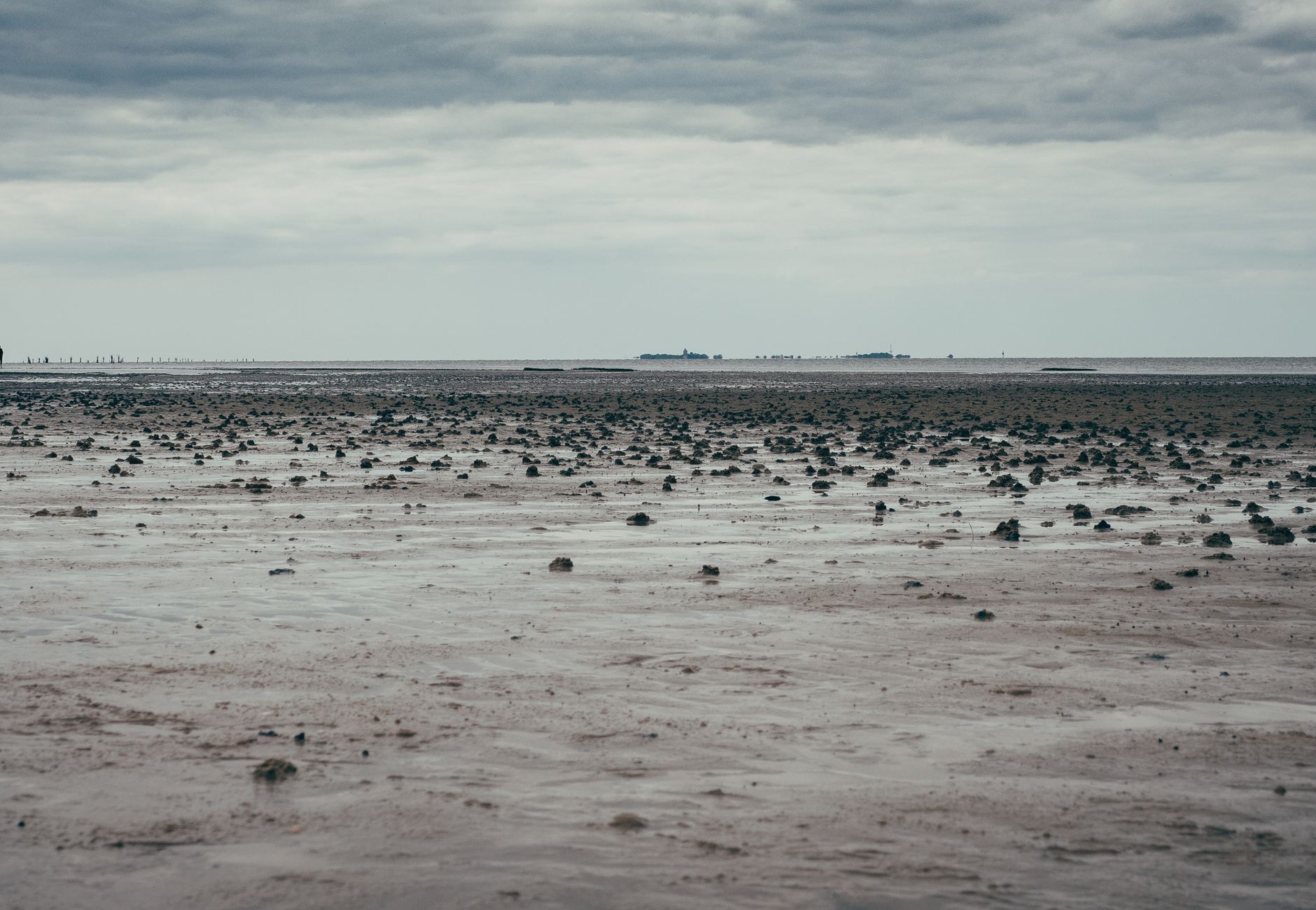 Photo by Maximilian Orlowsky on Pexels.
Most swimmers overlook tidal flats entirely. They head for breaking surf or deep channels. That's a loss.
The Temperature Factor
Seawater offshore sits in a relatively stable thermal band. Tidal flat water doesn't. Because the water is shallow (often only knee-deep even at high tide), it absorbs solar heat aggressively. On a warm afternoon, tidal flat water can reach 28–32°C, sometimes higher in enclosed estuarine pockets. That's bath water. Your skin responds accordingly.
Warm water is a vasodilator. Blood vessels near the skin's surface open up, blood flow increases, and your skin flushes. This is why immersion in tidal flat water feels so different from a cold ocean plunge: instead of the sharp vasoconstriction of cold surf, you get a slow, spreading warmth that moves through the skin layers rather than stopping at them. Your nerve endings, particularly thermoreceptors in the dermis, stay in a state of gentle activation the entire time you're in the water.
Skin also loses its barrier function slightly faster in warm water than cold. The lipid layer that keeps moisture in and irritants out becomes more permeable. This isn't dangerous in clean tidal environments, but it does mean the water's dissolved compounds reach your skin more directly.
What's Actually Dissolved in There
Tidal flat water is a cocktail. Start with the base: ocean water carries roughly 35 grams of dissolved salts per liter, dominated by sodium chloride but also magnesium, sulfate, calcium, and potassium. Tidal flat water tends to run saltier in shallow pools that have been baking under the sun, as evaporation concentrates everything left behind. Skin exposed to hypersaline flat water experiences strong osmotic pressure. Water moves out of your cells toward the higher salt concentration outside. Your skin tightens, sometimes noticeably.
Then there's the sediment layer. Tidal flats are built from fine silts and clays deposited over centuries, and this sediment is mineral-rich in ways that sandy beaches simply aren't. Kaolinite and illite clays are common in temperate tidal flats; both have mild adsorptive properties, meaning they pull oils and surface debris from skin on contact. This is why walking through tidal mud leaves skin feeling oddly clean after it's rinsed, not just dirty.
Organic matter adds another layer. Tidal flats are biologically dense environments. Diatoms, bacteria, and decomposing plant material all release compounds into the water column. Some of these, particularly humic acids from decomposing marsh grass, have demonstrated anti-inflammatory effects on skin in laboratory studies. Whether the concentrations in a typical tidal flat are sufficient to produce measurable changes is unclear. But the water doesn't feel like tap water. It has weight to it.
The Sensation of Moving Through It
Wading through shallow tidal flat water produces a specific set of tactile experiences. The water resistance is low, but the sediment creates drag at each step, changing the physical relationship between your legs and the water. Your skin registers this differently than swimming through open water: pressure sensations come from below and above simultaneously, from water pushing up against your soles and from surface water moving across your thighs.
Swimming flat-out in a tidal channel adds another dimension. Current moves through tidal cuts even when the surrounding flat is calm, and this current creates differential pressure across the skin's surface. Faster water over your back, slower water on your chest as you turn. The skin maps this pressure gradient in real time through mechanoreceptors distributed across the dermis.
When the light is low and the flat stretches out flat and glassy around you, the sensation is of being held rather than buoyed. The warm, dense water presses back.
Why Photographers Work Here
Tidal flats produce light that doesn't happen anywhere else. The reflective surface of a few centimeters of water over pale sediment creates a mirror effect that bounces soft, diffuse light upward. Skin photographed in these conditions is illuminated from below as well as above, which fills in shadows and produces an almost incandescent quality on wet surfaces.
Wet skin in tidal flat light catches this reflected glow differently than dry skin. The thin water film on the body acts as a secondary mirror, and the result is a layered luminosity that studio lighting struggles to replicate. Photographers who know tidal flats know this. The hour after dawn and the hour before sunset are when the flat turns into something extraordinary.
The water isn't backdrop. It's participant.
Get Wet Human in your inbox
New posts delivered directly. No spam.
No spam. Unsubscribe anytime.